4 Foot Farm Blueprint — Grow Upward, Not Outward
The 4 Foot Farm Blueprint is a downloadable small-space gardening guide by Sam McCoy that teaches United States beginners to grow vegetables vertically on roughly four square feet of ground — on a balcony, a patio or a sunny corner indoors — by stacking the growing space upward instead of spreading it out.
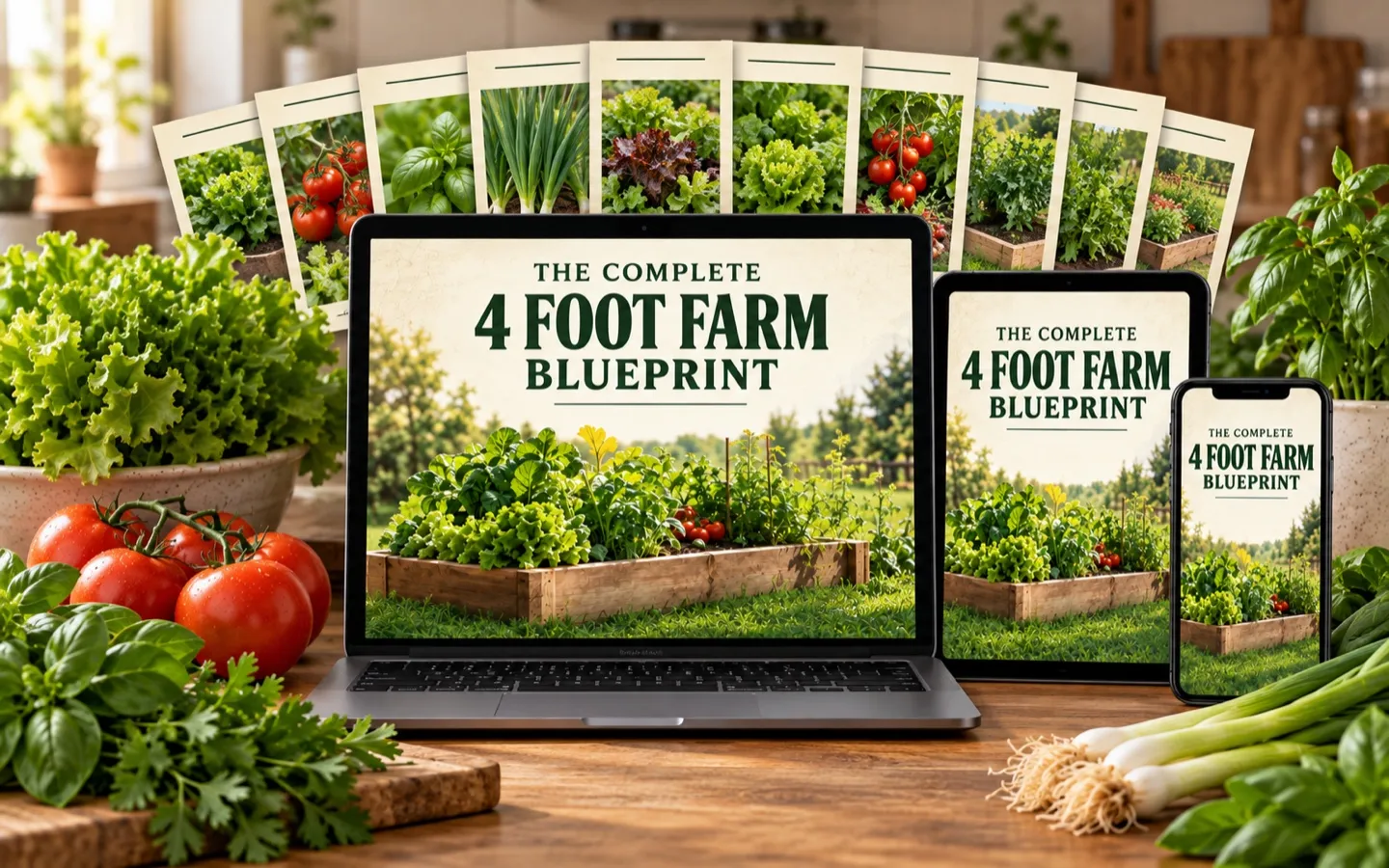
Why Do Gardeners Choose the 4 Foot Farm Blueprint?
BUILT UPWARD
The whole method rests on one idea: take four square feet of floor and extend the growing area vertically, so the same footprint holds several layers of plants instead of one.
NO YARD REQUIRED
A four-square-foot footprint fits a balcony, a patio corner or a bright windowsill, which is why the guide keeps coming up among renters and apartment dwellers.
LOW-BUDGET BUILDS
Budgeting is one of the guide's own chapters, and the appendices cover garden towers, bottle gardens and building your own containers rather than buying a kit.
FINISHABLE IN AN EVENING
Library and bookseller records list the work at roughly 49 to 58 pages depending on edition. It is a short, ordered starting point, not a gardening encyclopedia.
What Is the 4 Foot Farm Blueprint?
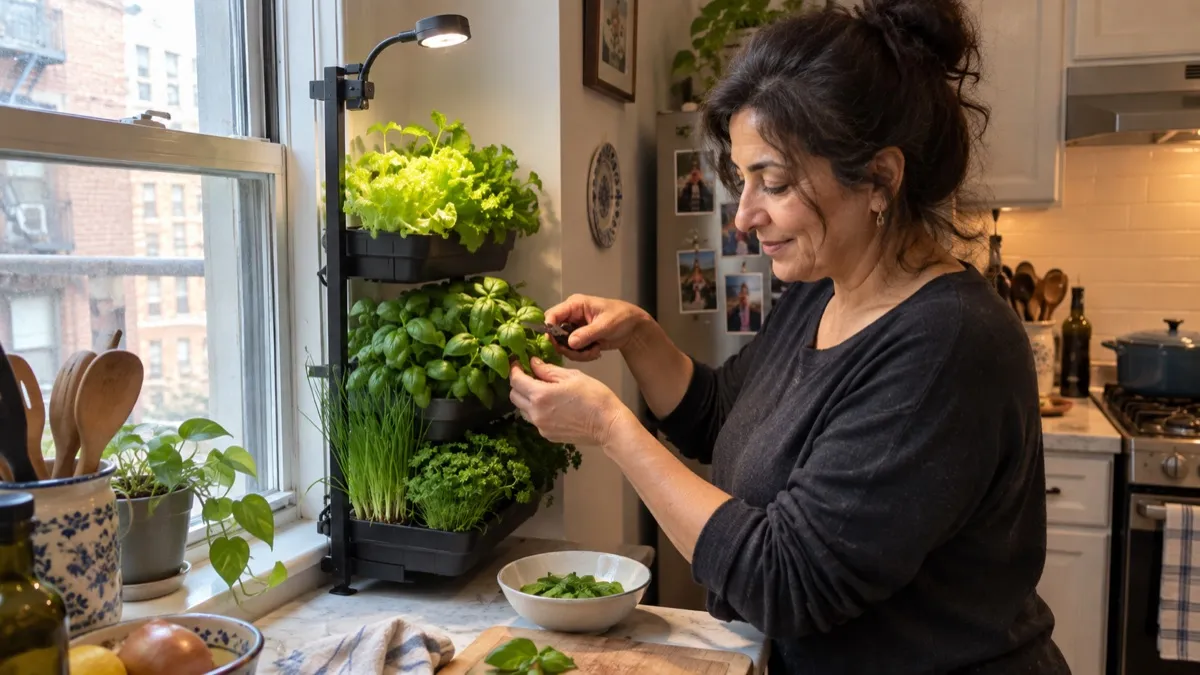
The 4 Foot Farm Blueprint is a downloadable gardening guide written by Sam McCoy. It explains how to produce vegetables and herbs from a growing area of roughly four square feet by planning that space upward — towers, stacked containers and improvised vertical structures — instead of spreading a flat bed across a yard you may not have.
Where does the idea come from? The publisher's own description points to the French botanist Patrick Blanc, known for living vertical walls, and to the old hanging-garden idea of growing on levels rather than on the ground. The full published title is “The 4 Foot Farm Blueprint: How to Feed Your Entire Family Off 4 Sq Ft for a Measly 10 Bucks a Month” — a marketing headline we think deserves tempering, and we say so plainly on our full review page.
The work is catalogued as a real published title: the Internet Archive library record lists Crisis Education, LLC of Austin, Texas as publisher with a 2013 date and ISBN 9781492355052, and Goodreads and ThriftBooks list the paperback at 52 pages. The offer you reach from this site is the digital download version, sold and processed through ClickBank.
What Are the Quick Facts About the 4 Foot Farm Blueprint?
| Product Name | 4 Foot Farm Blueprint |
| Author | Sam McCoy |
| Category | Digital small-space gardening guide |
| Method | Vertical growing on roughly four square feet |
| Core Chapters | Site selection, vertical planning, budgeting, growing medium, harvesting |
| Appendices | Garden towers, bottle gardens, container construction |
| Length | About 50 pages (52 in the 2013 paperback edition) |
| First Published | 2013 — Crisis Education, LLC, Austin, Texas |
| Print ISBN | 9781492355052 |
| Delivery | Digital download after checkout — nothing is mailed |
| Sold Through | ClickBank |
| Return Window | 60 days under ClickBank's standard policy; sellers may set their own terms |
| Price | One-time digital purchase — the current price is shown on the order page |
| Where to Get It | Check current price |
How Does the 4 Foot Farm Blueprint Work?
It works as an ordered sequence: pick the spot, plan the space upward, set a budget, prepare what the plants grow in, then harvest — in that order, so a first-timer is never guessing which step comes next.
What Does “Four Square Feet” Actually Mean?
It refers to the footprint, not the growing surface. A flat patch two feet by two feet gives you four square feet of soil and nothing else. Stand a tower, a stacked container run or a tiered frame on that same patch and the plantable surface multiplies with every level you add, while the floor space you occupy stays the same. That is the entire premise of the 4 Foot Farm Blueprint, and it is why the method transfers to a balcony as easily as to a back garden.
The publisher's description credits the same logic used in living plant walls — the work of French botanist Patrick Blanc is named directly — and in the layered terrace gardens of antiquity. The guide translates that idea down to something a renter can build over a weekend with inexpensive materials.
The Four Steps the Guide Walks You Through
Choose the Site
The opening chapter is about picking where the four-foot farm goes. Light is the constraint that decides everything after it, and getting this wrong is the single most common reason a first attempt dies.
Plan the Space Vertically
Next comes designing upward: how many levels the structure carries, what goes on each one, and how the plants above avoid shading the plants below.
Set the Budget and Prepare the Growing Medium
The guide dedicates separate chapters to keeping costs down and to what you actually fill the containers with. The appendices show garden towers, bottle gardens and how to build containers instead of buying them.
Harvest
The closing material covers harvesting from a compact vertical setup, including what to do with produce you cannot eat straight away and how surplus can be shared or bartered rather than wasted.
How is the 4 Foot Farm Blueprint delivered? As a digital download after checkout — nothing is shipped to you. The offer is processed through ClickBank, and questions about a purchase go to [email protected]. Separate paperback and Kindle editions of the underlying book exist through ordinary retail channels, but those are not what this offer delivers.
Why Do Most Small-Space Gardens Underproduce?
Most first attempts at growing food in a small space fail for boring, fixable reasons: the container sits somewhere too dark, the growing medium was an afterthought, the setup cost more than the produce it returned, or the whole thing was abandoned because no one said which step came first. None of those are talent problems.
Renters, condo residents and anyone with a balcony instead of a yard have nowhere to put a conventional bed in the first place.
Light decides the outcome before a single seed goes in, which is exactly why site selection is the first chapter rather than an afterthought.
Beds, bagged soil, tools and irrigation add up fast, and a garden that costs more than it returns rarely survives a second season.
Free gardening advice online is plentiful and contradictory. What beginners lack is a single sequence from empty corner to first harvest.
Where Beginner Setups Usually Go Wrong
Two of the four core chapters in the 4 Foot Farm Blueprint — site selection and preparing the growing medium — target the two failure points that end most first gardens. That is not a coincidence; it is how the guide is sequenced.
The third failure point is money. A compact footprint built from improvised containers keeps the outlay small enough that a disappointing first season is a lesson rather than a loss. The book's own subtitle references a running cost of about ten dollars a month, and an independent review at Success Reviews quotes the same figure — though what you actually spend depends on what you grow and where you live.
- A container placed where it looks tidy rather than where the light is
- Whatever soil was cheapest, in a container with no drainage plan
- A build that cost more than a season of grocery produce
- Ten browser tabs of conflicting advice and no starting point
What the 4 Foot Farm Blueprint Does About It
The guide answers each of those four problems directly, and it is honest about being a starting system rather than a complete reference.
Do you need a yard to use the 4 Foot Farm Blueprint? No. The method is designed around a footprint of roughly four square feet, which fits a balcony, a patio corner or a bright spot indoors. An independent review of the guide notes that it covers both indoor and outdoor setups. What you cannot skip is light: no growing method substitutes for sunlight or a grow light.
What Is Included in the 4 Foot Farm Blueprint?
The contents below come from the catalogued table of contents for the work, not from promotional copy. Each item is a section of the guide itself.
Site Selection
The 4 Foot Farm Blueprint opens by working out where the four-foot farm should go, because light, shelter and access to water decide what the rest of the plan can deliver. For an apartment grower this is the difference between a windowsill that works and one that does not.
Vertical Planning
The planning chapter designs the growing space upward rather than outward — how many tiers, what sits on each, and how to keep the upper levels from shading the lower ones. This is the part of the 4 Foot Farm Blueprint that separates it from ordinary container-gardening advice.
Budgeting
Cost gets its own chapter. The guide is written around keeping both setup and running costs low, which is where the book's much-quoted “ten bucks a month” subtitle comes from. Treat that as the author's target, not a promise about your utility bill.
Growing Medium Preparation
What goes inside the containers gets its own treatment: how to prepare a medium that holds water and nutrients in a shallow vertical container, which behaves very differently from open ground.
Harvesting
The harvesting material covers taking crops off a vertical setup and what to do with a surplus. An independent review also mentions a chapter on sharing and bartering extra produce — worth reading as neighbourly economics, not as an income opportunity.
Appendices: Towers, Bottle Gardens, Containers
Three appendices carry the build instructions: garden towers, bottle gardens and container construction. These are the pages that let you assemble the structure from cheap or reclaimed materials instead of buying a vertical planter kit.
A Short, Ordered Starting System
Put together, the 4 Foot Farm Blueprint is a compact path from an empty corner to a first harvest: pick the spot, build upward, keep the budget small, prepare the medium properly, then pick what grows. The current offer also includes a bonus recipe ebook, and it is sold through ClickBank, whose standard policy allows a return within 60 days of purchase.
How long before the 4 Foot Farm Blueprint produces anything? That depends on the crop and the season, not on the guide. Fast salad leaves and herbs can be cut within weeks of sowing, while fruiting crops such as tomatoes need most of a growing season. The 4 Foot Farm Blueprint shortens the planning stage, not the biology — nobody can promise you a harvest date.
What Are the Benefits of the 4 Foot Farm Blueprint?
These are the realistic gains, stated without the yield promises the product's own headline makes.
You Keep More of What You Grow
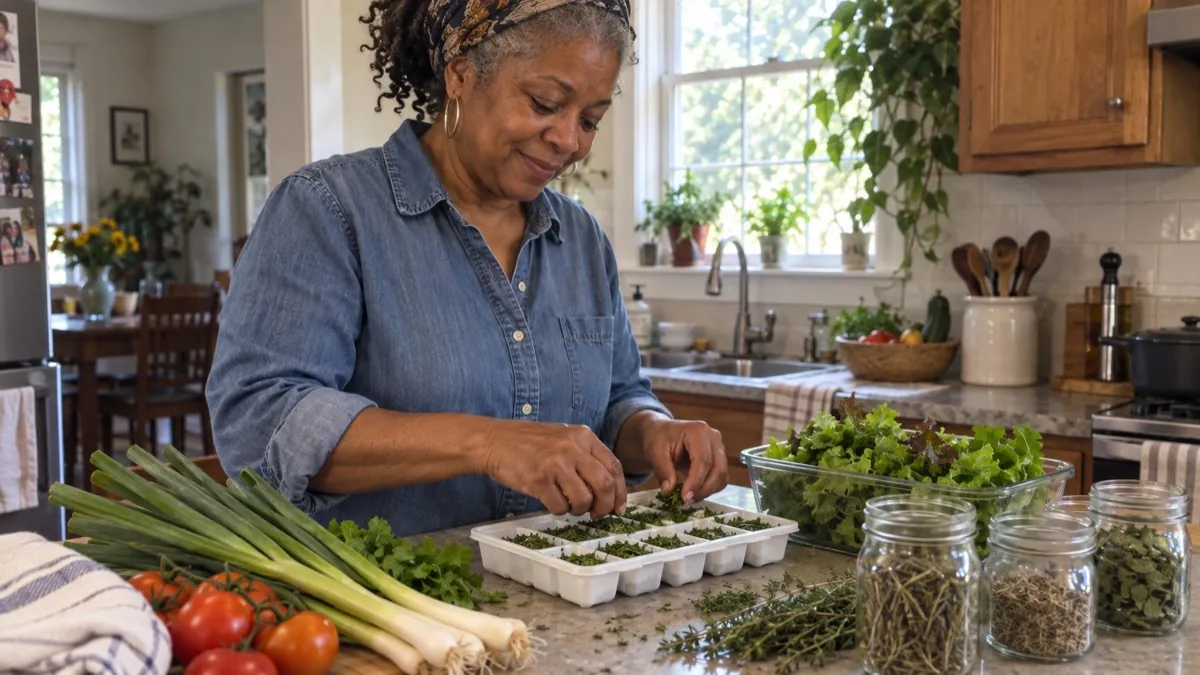
A compact vertical bed tends to produce in bursts, so the harvesting material matters as much as the planting. Freezing herbs, drying what you cannot use and passing surplus to neighbours are the difference between a productive corner and a compost heap.
A Small Bed Is Easy to Inspect
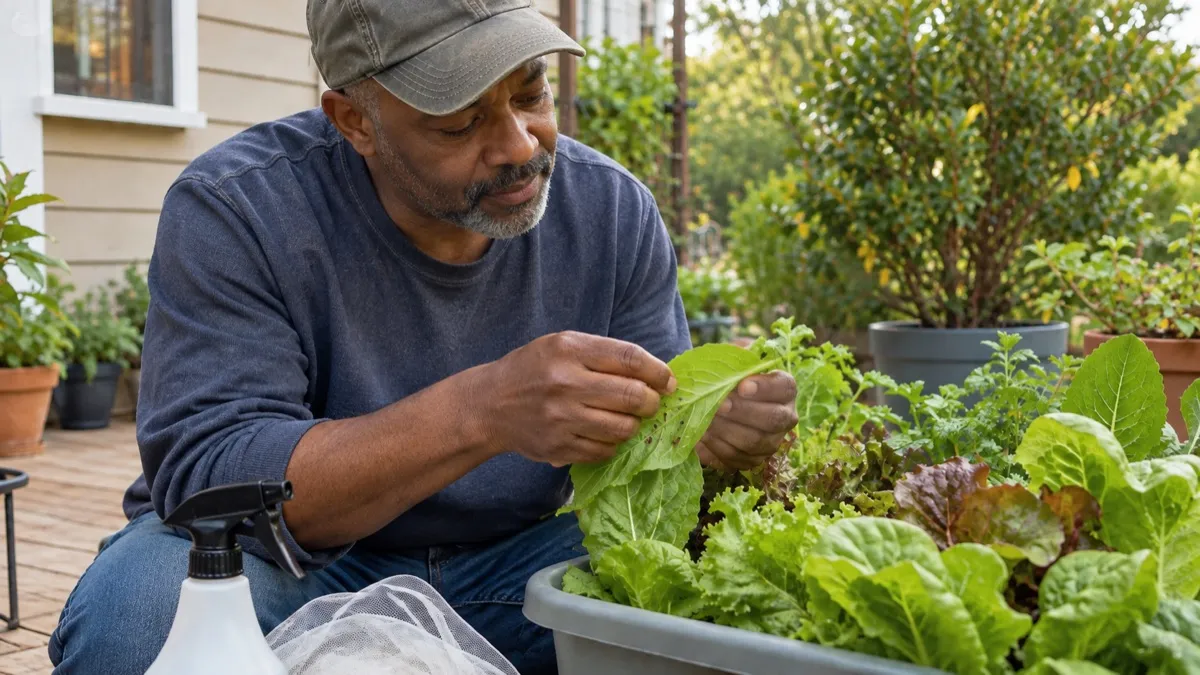
Four square feet can be checked leaf by leaf in a couple of minutes, which is how small problems get caught early. Be aware, though, that an independent review flags pest management as one of the thinner areas of this guide — we agree, and say so in our review.

Bonus: 53 Delightful Holiday Recipes eBook
The current offer includes a bonus recipe ebook, 53 Delightful Holiday Recipes, covering appetizers, drinks, soups and salads, main courses, classic sides and leftovers — a natural companion once the herbs and salad crops start arriving. The full bundle contents are listed on the order page at checkout.
What Are the Full Specifications of the 4 Foot Farm Blueprint?
Guide Specifications
| Product Name | 4 Foot Farm Blueprint |
| Full Title | The 4 Foot Farm Blueprint: How to Feed Your Entire Family Off 4 Sq Ft for a Measly 10 Bucks a Month |
| Author | Sam McCoy |
| Publisher of Record | Crisis Education, LLC — Austin, Texas |
| First Published | 2013 |
| Length | Approximately 49–58 pages by edition; 52 pages listed for the paperback |
| Print ISBN | 9781492355052 |
| Reading Level | Complete beginner — no prior gardening experience assumed |
| Growing Method | Vertical / stacked containers on a four-square-foot footprint |
| Setting | Outdoor balcony or patio, or indoors with adequate light |
| Crop Focus | Vegetables and herbs from seed you choose yourself |
| Language | US English |
What You Receive
| Main Product | The Complete 4 Foot Farm Blueprint (digital) |
| Bonus | 53 Delightful Holiday Recipes ebook |
| Other Bundle Items | Listed on the order page at checkout |
| Format | Digital download — no physical book is mailed |
| Access | Available after checkout completes |
| Retailer | ClickBank |
| Payment Methods | Major credit and debit cards through ClickBank's checkout |
| Price | One-time digital purchase — current price shown on the order page |
| Return Window | 60 days under ClickBank's standard return policy |
| Seller Terms | ClickBank allows sellers to set their own policy — check the order page |
| Support | Email: [email protected] |
| Where to Get It | Check current price |
How Does the 4 Foot Farm Blueprint Compare to the Alternatives?
Compared on format and approach only. Prices change constantly and we do not publish figures we cannot verify.
| Feature | 4 Foot Farm Blueprint | Square-Foot Gardening Books | Free Videos & Blogs | Extension-Service Guides |
|---|---|---|---|---|
| Format | Instant digital download | Printed book | Scattered video and articles | Free PDFs across many pages |
| Space Assumed | About four square feet | Yard space for grid beds | Varies wildly | Usually a real garden plot |
| Grows Upward | Core method | Sometimes a chapter | Occasionally | Occasionally |
| Ordered Beginner Path | Fragmented | |||
| Length to Finish | An evening | Weeks | Endless | Varies |
| Indoor Option Covered | Reported | Rarely | Varies | Rarely |
| DIY Container Builds | Three appendices | Varies | Varies | Often |
| Local Climate Accuracy | Generic | Generic | Varies | Region-specific |
| Return Window | 60 days via ClickBank | Retailer policy | N/A — free | N/A — free |
Who should not buy the 4 Foot Farm Blueprint? Experienced gardeners already running raised beds will find the material basic. Anyone expecting a printed book in the post should skip it, because nothing is mailed. And anyone with no usable daylight or grow light has a problem no guide can solve. Read our list of honest disqualifiers before buying.
Who Is the 4 Foot Farm Blueprint For?
The 4 Foot Farm Blueprint is aimed squarely at beginners in the United States who have very little space and want a short, ordered place to start.
- Renters and apartment dwellers with a balcony, a patio edge or one sunny windowsill and no ground to dig
- Complete beginners who have never grown anything and want the steps in order rather than a reference to browse
- Households offsetting part of a produce bill — herbs and salad crops first, since those return the most from the least space
- Self-reliance and homesteading readers who want a first step toward food independence that does not require acreage
- People who want to choose their own seed and know exactly what did and did not go onto their food
- Not for experienced growers, anyone wanting a physical book, anyone with no usable light, or anyone looking for an income opportunity — this is a gardening guide, nothing more
What Do Readers Say About the 4 Foot Farm Blueprint?
The comments below are illustrative reader feedback collected for this site. They are not verified purchases, they are not aggregated into a star rating, and they are not submitted to search engines as review data.
Carlos M. — Miami, FL
"Bottle-garden appendix, a drill, and a stack of two-litre bottles I was going to recycle anyway. Total spend was under twenty dollars. Cilantro, scallions and peppers going up the wall of a rented balcony where the landlord will never know it existed."
James R. — Austin, TX
"I read the whole thing in one evening, which is the only reason I actually finished a gardening book. Built the tower from the appendix out of scrap cedar the next Saturday. Two tiers of lettuce and one of basil on a four-foot patch of concrete patio — I have cut salad from it every week since May."
Linda S. — Phoenix, AZ
"Useful method, but it does not know where I live. Nothing in it accounts for a Phoenix summer, and my first attempt cooked in July because I followed generic spacing and watering advice. I got it working on the second try with a shade cloth and a local planting calendar from the extension service."
Megan K. — Portland, OR
"Honest take: it is short. If you already garden you will feel you paid for fifty pages of things you know. I did not already garden, so the order of the steps was exactly what I needed. The growing-medium chapter alone saved me from another tray of dead seedlings."
Patricia L. — Denver, CO
"The site-selection chapter was worth the whole download for me. I had been putting containers on the north side of the balcony for two years and wondering why nothing grew. Moved everything eight feet and the difference was obvious. I did want more on what to do about aphids, though — that part is thin."
Robert D. — Nashville, TN
"I bought it because I wanted to be less dependent on the grocery store and I have no yard. It is not going to feed my household and I never expected it to, but there is something genuinely satisfying about a tower of greens by the back door that cost almost nothing to build."
Start Your First Four-Foot Bed
If a balcony corner is all the space you have, the 4 Foot Farm Blueprint is a short, cheap way to find out what that corner can actually produce.
Get Instant AccessWhere Can I Get the 4 Foot Farm Blueprint?
Through the vendor's own ClickBank order page — the current price is shown there
THE 4 FOOT FARM BLUEPRINT
Digital Small-Space Gardening Guide by Sam McCoy

What is the honest downside of the 4 Foot Farm Blueprint? It is short, beginner-level and digital only, and an independent review notes thin coverage of pest management and long-term soil maintenance. The headline promise of feeding an entire family from four square feet needs tempering: treat the output as a supplement to groceries, not a replacement for them.
Frequently Asked Questions About the 4 Foot Farm Blueprint
No. The 4 Foot Farm Blueprint assumes you have never grown anything, own no tools and have no ground. Its real contribution is the order of operations — site first, then planning, then budget, then growing medium, then harvest — which removes the guesswork that ends most first attempts. The flip side is that it is beginner-level throughout: if you already run raised beds, there is very little here you do not know.
Free advice wins on depth and on local accuracy — a United States cooperative extension service publishes better pest and soil guidance than a fifty-page ebook ever could, at no cost. What free sources do not give you is one ordered path written for someone with four square feet and no confidence, finishable in an evening. That packaging is what the 4 Foot Farm Blueprint sells, and whether it is worth paying for depends on how much you value not assembling the sequence yourself.
As a digital download once checkout completes. There is no shipping, no waiting and no physical book in the post — an independent review lists digital-only delivery as a genuine drawback for readers who prefer paper. Separate paperback and Kindle editions of the underlying book exist through ordinary booksellers. Support for a purchase is by email at [email protected]; no published telephone line for the vendor was verifiable.
It is the idea that four square feet describes the footprint, not the growing surface. A flat two-by-two patch gives you one growing surface; a tower or tiered frame standing on that same patch gives you one per level, so the plantable area multiplies while the floor space stays fixed. The 4 Foot Farm Blueprint applies that principle — the same logic behind living plant walls and terraced gardens — to something a renter can build over a weekend.
It is covered by ClickBank standard return policy rather than a guarantee written by the vendor. ClickBank published support documentation states that it will, at its discretion, allow the return or replacement of any product within 60 days from the date of purchase. ClickBank also allows individual sellers to set their own terms, so read the refund terms shown on the order page before you buy.
Space is the easy part: roughly four square feet of floor, which fits a balcony corner, a patio edge or a bright windowsill. Time is honest rather than flattering. Expect a weekend for choosing the spot and building the structure, then a few minutes of watering and checking on most days — shallow containers dry out faster than open ground, so watering is quick but hard to skip in hot weather.
The 4 Foot Farm Blueprint is a downloadable small-space gardening guide written by Sam McCoy. It teaches one method: grow vegetables and herbs on a footprint of roughly four square feet by planning the growing space upward in tiers instead of spreading a flat bed across a yard. It is delivered as a digital file after checkout — nothing is posted to you. The underlying work is a real catalogued title, first published in 2013 with the print ISBN 9781492355052.
The catalogued contents cover five stages in order: choosing the site, planning the space vertically, budgeting the build, preparing the growing medium, and harvesting. Three appendices carry the build instructions for garden towers, bottle gardens and homemade containers. The current offer also includes a bonus ebook, 53 Delightful Holiday Recipes. We could not verify any video modules, app or members area, so we do not claim them — the order page itemises the full bundle at checkout.
Still have a question about a purchase? Email [email protected]
Get Instant AccessWhere Can You Learn More About the 4 Foot Farm Blueprint?
These in-depth guides each take one question about the 4 Foot Farm Blueprint and answer it properly, from what is inside the PDF to designing and building the structure yourself.
Which Sources Back Up This Page?
Every factual claim on this page traces to one of the independent records below. The vendor's own sales page is a client-side video presentation from which no text could be extracted, so nothing on this site is sourced from it — and, as an affiliate site, we do not link it directly.
- Internet Archive / Open Library catalogue record — “The 4 Foot Farm Blueprint: How to Feed Your Entire Family Off 4 Sq Ft for a Measly 10 Bucks a Month”. Publisher Crisis Education, LLC (Austin, TX), 2013, ISBN 9781492355052, plus the table of contents used for the chapter list on this page.
- Goodreads book listing for 4 Foot Farm Blueprint by Sam McCoy — author, 2013 publication date, 52 pages, and the publisher description referencing botanist Patrick Blanc and vertical growing.
- ClickBank Support — “ClickBank's Return and Subscription Cancellation Policy”, the source for the 60-day standard return window and for the fact that sellers may set their own terms. support.clickbank.com
- Google Books record for 4 Foot Farm Blueprint — independent bibliographic confirmation of the title and author.
About This Page
Written and reviewed by: 4 Foot Farm Blueprint Editorial Team
This page was researched and written by the 4 Foot Farm Blueprint Editorial Team from published catalogue records, bookseller listings, ClickBank's own policy documentation and independent third-party reviews. We are an independent affiliate site, not the vendor. Where we could not verify something — the current price, the full bundle contents, any customer rating — we say so instead of filling the gap. Last updated September 2026.
The 60-Day Return Window Explained
How Does the Checkout Work?
The 4 Foot Farm Blueprint is sold through ClickBank, which handles the payment page, the receipt and the refund process. Card details are entered on ClickBank's encrypted checkout rather than on this site — we never see them. The button above sends you to our order page, which forwards you to the vendor's ClickBank offer.
Results Disclaimer
What a four-foot farm produces depends on your climate zone, available light, season, growing medium and the effort you put in. No particular harvest, yield or grocery saving is promised anywhere on this site, and the guide's own headline about feeding an entire family should be read as marketing, not as a forecast.
Refunds
ClickBank's standard policy allows a return or replacement within 60 days of purchase, and sellers may set their own terms on top of that. Refund requests are handled by ClickBank using the order number on your receipt.
For anything else, contact support by email.