| Product | 4 Foot Farm Blueprint |
| Author | Sam McCoy |
| Our Editorial Score | 4.2 / 5 |
| Best For | Renters, balcony growers, absolute beginners |
| Method | Vertical growing on about four square feet |
| Format | Digital download — nothing is mailed |
| Length | About 50 pages |
| Price | Shown on the order page at checkout |
| Return Window | 60 days under ClickBank's standard policy |
| Verdict | Worth it for beginners with no space ✓ |
The 4 Foot Farm Blueprint is a short downloadable gardening guide by Sam McCoy that teaches one specific method: grow vegetables and herbs on a footprint of roughly four square feet by building the growing space upward in tiers instead of spreading it across a yard.
Before we say anything about it, here is what this review is and is not. We did not plant a test garden and photograph it for eight weeks; you cannot honestly “field test” a fifty-page PDF in a way that separates the book from the weather. What we did do was work through the material and the public record around it — the catalogued table of contents, the publisher data, the independent reviews — and assess it as a piece of instructional writing: is the sequence sound, is anything important missing, and who is it actually useful to?
Three things define the product, and it is worth being precise about each of them:
The footprint stays at four square feet; the plantable surface grows with every tier you add. That single idea is what the whole guide is organised around.
Site selection, then vertical planning, then budgeting, then the growing medium, then harvesting. Beginners fail on ordering as often as on technique.
Three appendices cover garden towers, bottle gardens and container construction — the practical pages that keep the setup cost near zero.
The work itself is properly catalogued, which matters when you are deciding whether an online offer is real. The Internet Archive library record lists the full title as “The 4 Foot Farm Blueprint: How to Feed Your Entire Family Off 4 Sq Ft for a Measly 10 Bucks a Month”, published by Crisis Education, LLC of Austin, Texas in 2013, ISBN 9781492355052.
That subtitle is also the guide's biggest credibility problem, and we will come back to it. Four square feet, however well planned, does not feed a household. Treat it as a supplement to the produce aisle and the guide becomes reasonable; treat the headline literally and you will be disappointed.
Bottom line: The 4 Foot Farm Blueprint is a real, catalogued, beginner-level guide to vertical small-space growing, sold as a digital download through ClickBank. It is a starting system for people with no yard — not a comprehensive gardening reference, and not the family food supply its own subtitle implies.
The author is Sam McCoy. Goodreads, ThriftBooks, Google Books and the Internet Archive all list him consistently as the author of this title, so the attribution is solid.
Beyond that, we are going to disappoint you. Several review pages circulating online describe him as a self-reliance advocate who developed the method over years of experimentation. We could not verify a single word of that against any authoritative source, so we are not repeating it as fact. What is documented is the publishing record: Crisis Education, LLC of Austin, Texas is the publisher of record for the 2013 library edition, and CreateSpace handled the print edition.
Support for the offer itself is by email, at [email protected]. No published telephone line for the vendor was verifiable, so if you see one quoted on another review site, treat it with caution.
You get a digital file after checkout. Nothing is posted to you, there is no box, and there is no waiting. That is worth stating plainly because an independent review lists “digital only, no physical book” as a genuine drawback for some buyers, and we agree — if you like to annotate a paper copy in the garden, this format will annoy you.
Site selection. The opening material is about choosing where the four-foot farm goes. It is the right place to start: light availability constrains everything downstream, and a container in the wrong corner cannot be rescued by better technique later.
Vertical planning. The design chapter covers building upward rather than outward — how many levels, what occupies each, and how to stop the upper tiers from shading the lower ones. This is the section that justifies the product's existence.
Budgeting. Cost gets its own treatment, which is unusual for a gardening guide and genuinely useful for the audience it targets. The often-quoted ten-dollars-a-month figure comes from here and from the book's subtitle.
Growing medium. What goes inside the containers. Shallow vertical containers dry out and deplete far faster than open ground, so this chapter is doing real work.
Harvesting, plus three appendices. Harvesting closes the main text; the appendices cover garden towers, bottle gardens and container construction — the build instructions that let you assemble the structure cheaply.
What we could not confirm: whether the current offer adds video modules, a members' area or any software. The vendor's sales page is a video presentation from which no text is retrievable, so we describe only what the catalogued contents establish. The exact bundle you receive is itemised on the order page at checkout.
This is the question that decides whether the purchase is worth it, so we assessed the material the way you would assess any instructional text: can a person with zero experience follow it from start to finish without getting stuck or needing a second book?
Largely, no. The sequence is written for people who have never grown anything, and an independent review at Success Reviews makes the same observation about its step-by-step, beginner-first framing. There is no assumption that you own tools, have a yard, or know what a growing medium is.
Yes, and this is the guide's quiet strength. Site selection comes before planning; planning comes before spending; the medium is prepared before anything is planted. Most free online advice hands you a planting calendar and lets you discover three months later that the balcony faces north.
Three places, and we would rather you hear them from us than discover them after buying. Pest management is thin — an independent reviewer flags the same gap, and so do we. Long-term soil and nutrient maintenance across seasons gets far less attention than the initial setup. And because the guide is written generically, it does not tell a reader in Phoenix anything different from a reader in Minneapolis, even though the two need almost entirely different planting calendars.
Comfortably, in one evening. At roughly fifty pages, the 4 Foot Farm Blueprint is short enough that you will actually read it, which is more than can be said for the four-hundred-page gardening encyclopedias most beginners buy and abandon. That is a real advantage, not a euphemism for “thin”, though it is both.
An independent review states that the vertical plans cover both indoor and outdoor setups, which matters for renters and cold-climate readers. Our caveat is unchanged and non-negotiable: indoors you must supply the light. A grow light is an extra cost the ten-dollars-a-month framing does not include.
Usability verdict: Strong on sequencing and accessibility, weak on depth. The 4 Foot Farm Blueprint gets a beginner from an empty balcony to a planted vertical bed without a second source. Keeping that bed healthy through a second season will require one.
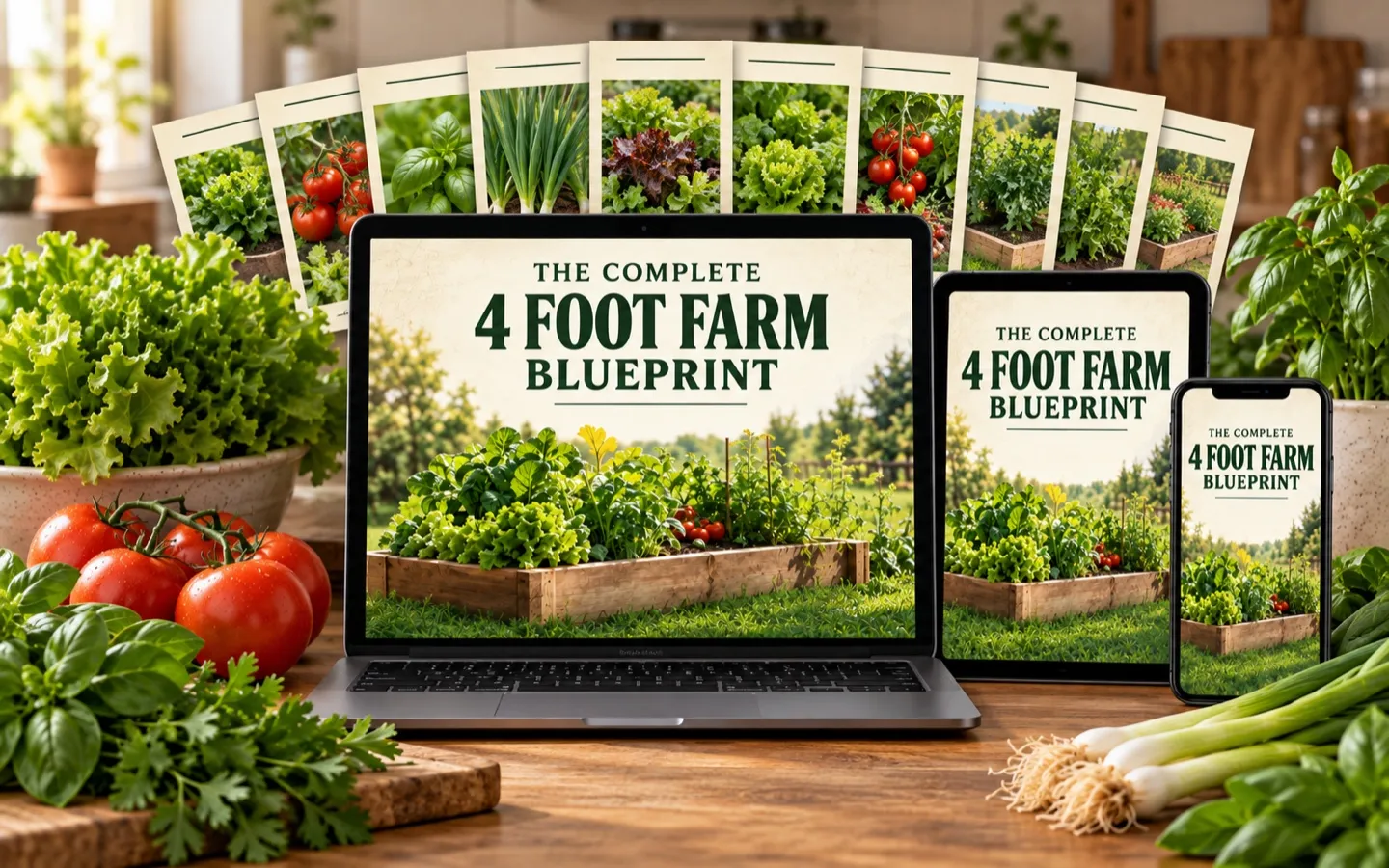
“Four square feet” sounds like a marketing number, and we approached it as one. It is not, but it is also not what most people assume when they read it.
The number describes the footprint, not the growing surface. A flat two-by-two patch gives you four square feet of soil. A tower or tiered frame standing on that same patch gives you four square feet of floor and several times that in plantable surface. Nothing is being invented here — it is the same principle behind the living plant walls associated with the French botanist Patrick Blanc, whom the publisher's own description names directly, and behind every terraced garden in history.
That a well-planned vertical four-square-foot setup will substantially out-produce a flat patch of the same area. That is straightforwardly true, and it is the claim the guide is actually built on.
Feeding an entire family from it. The subtitle says exactly that, and it is not a promise we will defend. Light, season length, crop choice and your own consistency set the ceiling, and for most households that ceiling is salad leaves, herbs and some fruiting crops in season — a useful supplement to the grocery bill, not a replacement for it. Anyone quoting you a specific annual dollar saving from four square feet is making it up.
For the target reader, yes. If your alternative is no garden at all because you have no ground, a method designed around a balcony corner is not a gimmick — it is the only version of gardening available to you.
Our take: The vertical method in the 4 Foot Farm Blueprint is legitimate horticulture applied to a very small space. The headline wrapped around it is marketing. Buy it for the method, and ignore the subtitle.
The current offer includes a bonus ebook titled 53 Delightful Holiday Recipes. Its cover lists the sections it contains: appetizers, drinks, soups and salads, main courses, classic sides, leftovers and classic stars.
More sensible than it first appears. A four-foot farm producing herbs, salad leaves and scallions creates a small, steady supply that most beginners waste because they have no plan for it. A recipe collection is a reasonable, if slightly generic, answer to that problem. It is not gardening instruction, and it does not make up for the thin pest chapter.
You will find pages online listing a planting calendar, a companion planting guide, a preservation guide and even a space-visualiser app as part of this offer. We could not verify any of those against the actual checkout our link reaches, and several appear to originate from a different funnel on a similarly named domain. We are not going to list them as included when we cannot confirm it. The order page itemises the current bundle at checkout — read it there before you buy.
Not materially. Buy the 4 Foot Farm Blueprint because the vertical method suits your space, not because of the recipes. Treat the ebook as a pleasant extra rather than half the value.
Bonus verdict: One confirmed bonus, the 53 Delightful Holiday Recipes ebook. Anything else you see advertised as part of this bundle should be checked on the order page rather than taken from a review site — including this one.
Longer than the sales language suggests, and entirely outside the guide's control. What follows is a realistic shape of a first season for someone starting from nothing — not a schedule, and certainly not a promise.
| Stage | What You Are Doing | What the Guide Gives You | Realistic Expectation |
|---|---|---|---|
| Evening one | Reading the guide end to end | The full sequence | Done in a single sitting |
| First weekend | Choosing the spot and building the structure | Site and build appendices | A standing setup, nothing growing |
| Weeks 2–4 | Filling, sowing and watering | Growing medium chapter | Germination, no harvest |
| Weeks 4–8 | Thinning, watering, watching for pests | Limited pest coverage | First cuttings of fast leaves and herbs |
| Rest of season | Fruiting crops maturing, succession sowing | Harvest chapter | Entirely climate and light dependent |
Salad leaves, radishes and cut-and-come-again herbs are the fast payoff; tomatoes and peppers need most of a season and a lot of light. None of that is specific to this guide — it is how plants work — but it is the honest answer to “how soon”.
Where the 4 Foot Farm Blueprint genuinely saves you time is at the front: the decision-making. Removing two weeks of research and one wrongly placed container is a real benefit. It cannot shorten germination.
Timeline verdict: Expect a built setup within a weekend and first leafy cuttings within roughly a month of sowing in decent conditions. Anyone promising you a specific harvest, yield or grocery saving from four square feet is guessing — your climate zone, light and consistency decide it.
Based on this assessment, the 4 Foot Farm Blueprint suits a fairly specific reader:
If your entire outdoor space is a balcony, a fire escape landing or a patio edge, this guide was written with exactly that constraint in mind.
If you have never grown anything and want the steps in the right order rather than a reference to browse, the short ordered format is the point.
If a past container garden died, the two chapters on site selection and growing medium address the two most common reasons why.
The DIY tower, bottle-garden and container appendices are aimed at people who would rather build than buy a vertical planter kit.
If food independence is the motivation, this is a sensible first step that does not require land — as long as expectations stay proportionate to four square feet.
Fifty pages you actually read beats four hundred you do not. If long gardening books defeat you, brevity is a feature here.
We would rather lose the sale than have you buy something that does not fit. The 4 Foot Farm Blueprint is not for you if any of these describe you:
Here we have to be blunt, because this is where most pages about this product invent things. There is no published customer rating or review count for the digital 4 Foot Farm Blueprint offer. None. Any page showing you “4.7 out of 5 from thousands of verified buyers” has made that up, and we will not join them.
What does exist is limited and worth reporting accurately:
| Source | What it shows | How much weight to give it |
|---|---|---|
| Goodreads | 3.43 out of 5 from 14 ratings, with no written reviews — and that is for the print edition, not this digital offer | Small sample, different format. Indicative at best. |
| Success Reviews | An independent pros-and-cons write-up praising the low barrier to entry, indoor/outdoor flexibility and non-GMO focus, while flagging thin pest coverage | A single reviewer's opinion, but a specific and checkable one. |
| The vendor's own page | No retrievable text at all — it is a video presentation | None. Nothing on this site comes from it. |
| Assorted “review” blogs | Star scores, letter grades and buyer counts that appear nowhere else | None. These are affiliate pages recycling each other. |
Review analysis: The honest summary is that the crowd has not spoken loudly about this product. Judge it on its contents and its 60-day return window rather than on a star rating, because no trustworthy star rating exists.
We have deliberately left prices out of this table. Competitor pricing shifts constantly and we do not publish figures we have not confirmed ourselves.
| Criteria | 4 Foot Farm Blueprint Digital guide | Square-Foot Gardening books | Extension-service guides Free PDFs | Vertical planter kits Hardware |
|---|---|---|---|---|
| What you actually buy | A method, as a download | A comprehensive reference | Nothing — it is free | Physical equipment |
| Works with no yard | Needs bed space | Varies | ||
| Grows upward | Core method | Occasionally a chapter | Occasionally | By design |
| Ordered beginner path | Fragmented | Assembly only | ||
| Depth on pests and soil | Thin | Strong | Strong | N/A |
| Region-specific accuracy | Generic | Generic | Local | N/A |
| Time to finish reading | An evening | Weeks | Varies by leaflet | N/A |
| Available instantly | Shipping | Shipping | ||
| Return window | 60 days via ClickBank | Retailer policy | N/A | Retailer policy |
Comparison verdict: Free extension-service publications beat the 4 Foot Farm Blueprint on horticultural depth and local accuracy, and they always will. What they do not offer is one ordered path, written for someone with four square feet and no confidence, finishable in an evening. That packaging is what you are paying for — and whether it is worth it depends on how much you value not having to assemble the sequence yourself.
The digital 4 Foot Farm Blueprint is sold through ClickBank, and the current price appears on the vendor's order page at checkout. We are not going to print a figure here, and we would encourage you to be sceptical of any review site that does.
| Figure you may see online | Where it comes from | Our position |
|---|---|---|
| The paperback list price | ThriftBooks, for the printed 2013 edition | Real, but it is the print edition — not this digital offer |
| Promotional and “regular” prices | A similarly named but different domain | Not the checkout our link reaches. We will not republish it. |
| “Original” struck-through prices | Affiliate pages recycling each other | Unverifiable, and struck-through anchors are a marketing device |
| The actual current price | The vendor's ClickBank order page | The only figure we consider reliable |
* One-time digital purchase. The current price, the full bundle contents and the seller's own refund terms are all displayed at checkout before you pay.
Our test is simple. If the price is around what a single takeaway meal costs, and you genuinely have no yard and no idea where to start, then a short ordered method plus a 60-day return window is a reasonable risk. If the price sits closer to what a well-regarded, four-hundred-page gardening reference costs, the value case weakens sharply — that reference will serve you for years, and this will not.
The return window is doing a lot of the work in that calculation. ClickBank's published policy allows a return or replacement within 60 days of purchase, and sellers may set their own terms on top of it. Read the guide the evening you buy it, decide whether the method fits your space, and act within the window either way.
Instant digital download — 60-day ClickBank return window
It is legitimate — meaning a real, identifiable product by a named author, sold through a major retailer with a return policy. That is a lower bar than “good”, so here is the evidence on both sides.
Our verdict: The 4 Foot Farm Blueprint is legitimate but oversold. The guide is real and the method is sound; the marketing around it promises more than four square feet can deliver. Buy it for what it is, use the 60-day window, and keep your expectations proportionate.
This is the 4 Foot Farm Blueprint Editorial Team's own assessment of the guide. It is not a customer rating, and no customer rating for this product exists.
| Beginner-friendliness | 4.5 / 5 |
| Clarity of the step sequence | 4.5 / 5 |
| Fit for very small spaces | 4.5 / 5 |
| Value for a short digital guide | 4.0 / 5 |
| Depth on pests, soil and climate | 3.5 / 5 |
| OVERALL EDITORIAL SCORE | 4.2 / 5 |
The 4 Foot Farm Blueprint earns a qualified recommendation: buy it if you have almost no space and almost no experience, and skip it if either of those is untrue.
It does one thing well — it turns “I have a balcony and no idea” into an ordered plan you can act on this weekend, for the price of a small download and with a 60-day return window behind it. What it will not do is make you self-sufficient, teach you to handle a pest outbreak, or tell you anything specific about your own climate zone. Go in with that understanding and it is a fair purchase. Go in expecting the subtitle, and it is not.
Instant download — bonus recipe ebook — 60-day ClickBank return window
Four recur. It is short and beginner-level, so experienced gardeners find little new in it. Pest management and long-term soil maintenance are thin — an independent reviewer flags the same gap. It is generic about climate, giving a reader in Arizona the same advice as one in Minnesota. And it is digital only, with nothing mailed. Underneath all of them sits the biggest issue: a subtitle promising to feed an entire family from four square feet.
Through ClickBank, not through this site and not directly with the vendor. ClickBank published policy states it will, at its discretion, allow the return or replacement of any product within 60 days from the date of purchase, using the order number on your receipt. Sellers may set their own terms on top of that, so read the order page before buying. Questions about a purchase can be sent to [email protected].
Longer than the marketing implies, and it is not up to the guide. Realistically: one evening to read it, one weekend to choose the spot and build the structure, two to four weeks to germination, and first cuttings of fast leaves and herbs roughly a month after sowing in decent conditions. Fruiting crops such as tomatoes need most of a growing season. What the 4 Foot Farm Blueprint shortens is the planning stage, not the biology.
Legitimate, but oversold. It is a genuinely catalogued published work — print ISBN 9781492355052, listed by the Internet Archive, Goodreads, Google Books and mainstream booksellers, with a named author in Sam McCoy and a named publisher of record in Crisis Education, LLC of Austin, Texas. It is sold through ClickBank with a 60-day standard return window. What is not credible is the headline: four square feet does not feed an entire family, whatever the subtitle says.
It earns a qualified yes from our editorial team, scoring 4.2 out of 5. Buy it if you have almost no space and almost no experience: it turns a bare balcony and no idea into an ordered plan you can act on this weekend, backed by a 60-day ClickBank return window. Skip it if either of those is untrue. It will not make you self-sufficient, it will not teach you to handle a pest outbreak, and it says nothing specific about your own climate zone.
Written and reviewed by: 4 Foot Farm Blueprint Editorial Team
This review was written by the 4 Foot Farm Blueprint Editorial Team. It is a documentation review, not a field trial: we assessed the guide's structure, contents and gaps against the public catalogue record, the publisher's description and independent third-party reviews, and we state plainly where we could not verify something. We are an independent affiliate site, not the vendor. This page contains affiliate links — if you buy through them we earn a commission at no extra cost to you, and it has not changed a word of the criticism above. Last updated September 12, 2026.