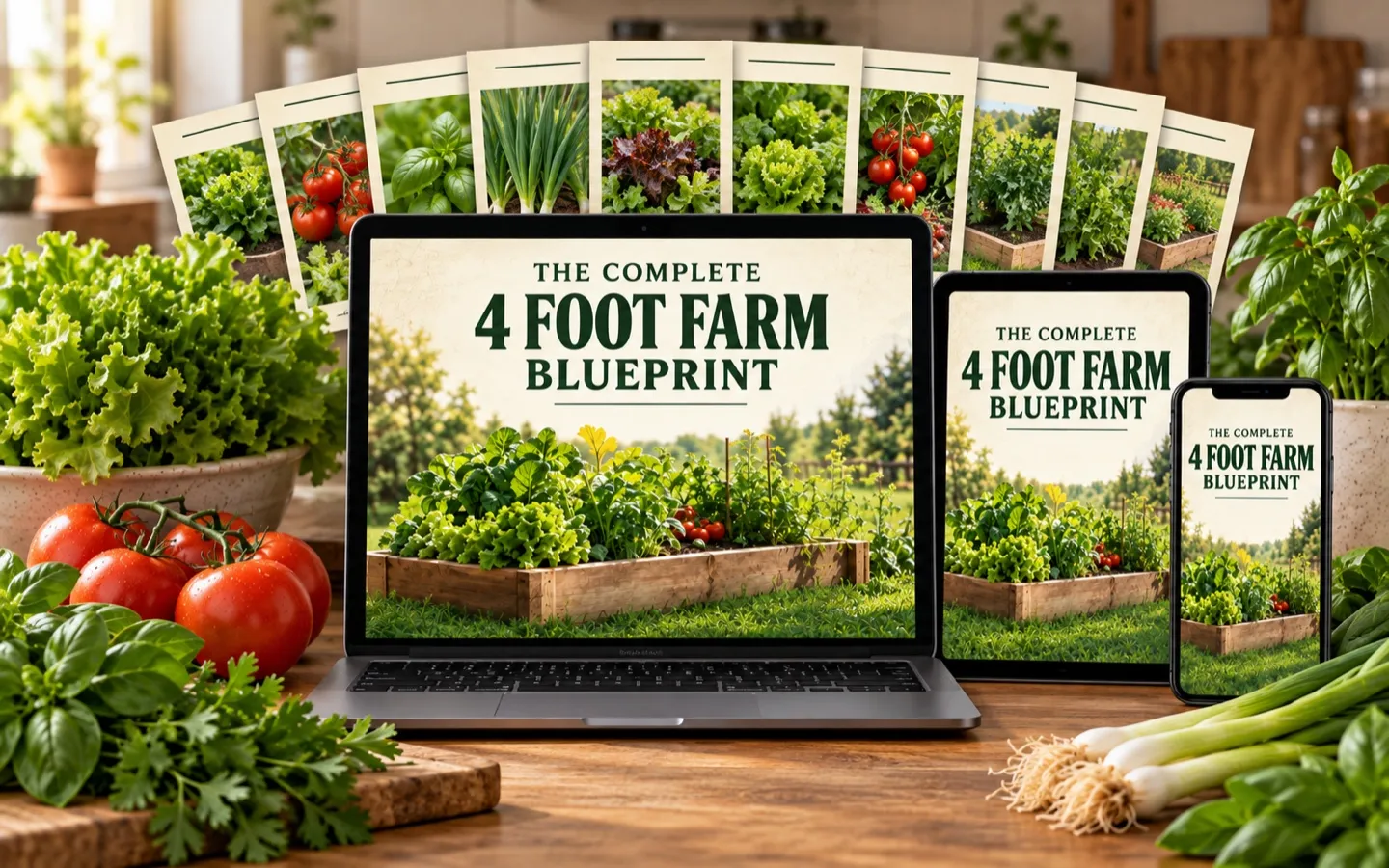
The 4 Foot Farm Blueprint PDF is the downloadable edition of Sam McCoy's vertical gardening guide: roughly fifty pages that take a first-time grower from picking a spot to harvesting from a growing structure with a four-square-foot footprint.
Most pages about this product tell you what it promises. This one opens the book instead. Below you will find the catalogued table of contents, what each chapter helps you decide, how the editions differ, how long the read takes, and the subjects you will need a second source for.
Everything about the contents comes from library and bookseller records, listed at the bottom of the page. Where a record is silent, so are we.
Check the Current PriceIt is a short, beginner-level book in digital form, built around one method: grow food upward in tiers so a tiny footprint holds more plants than a flat patch could. Its full catalogued title is “The 4 Foot Farm Blueprint: How to Feed Your Entire Family Off 4 Sq Ft for a Measly 10 Bucks a Month”, published in 2013 by Crisis Education, LLC of Austin, Texas. Read the subtitle as a title, not a yield figure.
Five main chapters, in this order: site selection, vertical planning, budgeting, growing medium preparation and harvesting, followed by appendices on garden towers, bottle gardens and container construction.
That sequence comes from the Internet Archive catalogue record for the 2013 edition. The record lists chapter topics, not sub-headings, so the notes below describe the decision each chapter exists to settle rather than quoting its pages.
Site selection comes first because every later choice depends on it. A balcony that gets three hours of direct sun supports different crops than a south-facing patio, and moving a planted tower is a nuisance. The chapter's job is to get you to commit to a location before you spend anything.
Vertical planning is the core of the method. The guide's publisher description ties the idea to French botanist Patrick Blanc and to the hanging gardens of ancient Babylon, and the practical question is how to stack growing levels without the top tier shading the bottom one. If layout is the part you care about most, our guide to laying out tiers, light and spacing goes much further than this summary.
Budgeting sits before any building, which is the right order. Its purpose is to keep the project small and improvised, in line with the book's “10 bucks a month” subtitle. Treat that figure as the author's framing; your own costs will depend on what you already own and what you grow.

Does the 4 Foot Farm Blueprint PDF list crop-by-crop instructions? The catalogue record does not show a crop directory as a chapter. The 4 Foot Farm Blueprint is organized around decisions (place, plan, cost, medium, harvest), and an independent review describes its crop guidance as a non-GMO focus rather than an encyclopedia of varieties.
Growing medium preparation covers what fills the containers. This matters more in a vertical setup than in open ground, because shallow pockets dry out and compact quickly. General container-gardening practice favors a light, well-draining mix over garden soil dug from a yard, and this chapter is where the guide addresses that step.
The last main chapter covers harvesting methods. A third-party review also mentions material on sharing and bartering surplus produce. That is useful for neighbors with too much lettuce; it is not a money-making plan, and we do not describe it as one.
| Section | Topic (catalogued) | The decision it helps you make |
|---|---|---|
| Chapter 1 | Site selection | Which spot has the light to support a farm |
| Chapter 2 | Vertical planning | How many tiers, and how to keep them from shading each other |
| Chapter 3 | Budgeting | How much to spend before the first seed goes in |
| Chapter 4 | Growing medium preparation | What to fill the structure with |
| Chapter 5 | Harvesting methods | When to pick and what to do with the extra |
| Appendices | Garden towers, bottle gardens, container construction | Which structure to build for your space |
The appendices turn the plan into something you can physically build, with one section each on garden towers, bottle gardens and container construction.
Think of the chapters as the reasoning and the appendices as the workshop. Readers tend to skim the first part and live in the second once the weekend project starts.
A stacked, upright structure that suits a patio or balcony corner where floor space is the hard limit.
Growing in repurposed bottles, which fits the book's low-budget angle and lighter setups such as railings and walls.
Making your own planters rather than buying them, for readers who want something sturdier or a custom size.
This page stops at what the appendices are for. Materials, tools and the actual assembly steps belong on our walkthrough for building towers, bottle gardens and containers.
The honest limit: three build options in a book of about fifty pages means none of them is a detailed carpentry manual. If you have never used a drill, plan on watching a general how-to video for the tool work itself.
Expect somewhere between 49 and 58 pages. The number shifts with the edition and with how each catalogue counts front matter.
What we cannot tell you is whether the 2014 file reorders or expands any chapter, because we were unable to render that PDF for a page-by-page comparison. The file delivered after a ClickBank checkout is also the vendor's choice, so the edition label inside your copy is the one to trust.
Is the PDF edition longer than the paperback? Not in any meaningful way based on the records available. Every catalogued count for the 4 Foot Farm Blueprint lands close to fifty pages, so the digital file is best understood as the same short guide in a different container.
The words are the same short guide; the difference is how you read it, where you get it and what comes alongside it.
| Feature | PDF (ClickBank offer) | Paperback | Kindle |
|---|---|---|---|
| Delivery | Digital file after checkout | Shipped by a bookseller | Sent to a Kindle app or device |
| Page layout | Fixed pages, as designed | Fixed printed pages (52 listed) | Reflowable text that adapts to screen size |
| Search within the text | Yes, in most PDF readers | No | Yes |
| Comfort on a small phone | Needs zooming and scrolling | Not applicable | Good |
| Take outside while building | Only on a device, or printed pages | Best of the three | Only on a device |
| Bonus ebook | 53 Delightful Holiday Recipes is part of the current offer | Not listed with this edition | Not listed with this edition |
| Returns | ClickBank's standard 60-day window; sellers may set their own terms | The bookseller's own policy | Amazon's own policy |
For most readers the choice comes down to one question: will you mostly read at a desk or tablet, or with soil on your hands? The PDF wins at a screen. Paper wins in the yard. Kindle is the easiest read on a phone but loses the fixed layout that diagrams and step pages rely on.
If you decide on the PDF, the checkout itself is explained on our step-by-step page on buying and accessing the download, and getting the file onto each of your devices is covered in the guide to opening, printing and backing up the PDF.
A straight read-through of roughly fifty pages takes most adults an hour or two; studying it well enough to act on takes a few short sessions spread over about a week.
Reading it once is easy. The trap is finishing in one evening, feeling ready, and buying containers before you know where the light falls. A slower pass that matches the book's own order avoids that. Here is a study plan we suggest, built directly on the chapter sequence:
The honest limit: reading time is not growing time. The guide can be finished in an evening; the first harvest from salad leaves takes weeks and fruiting crops take most of a season. Our full review of the 4 Foot Farm Blueprint covers realistic timelines in more detail.
Pest management, regional planting calendars and long-term soil science are the three thin areas, and each one is easy to fill with a second source.
None of them appears as a chapter in the catalogued table of contents, and the independent Success Reviews write-up names pest management and long-term soil upkeep as weak spots. A guide this short has to choose, and this one chose setup over troubleshooting.
Our breakdown of each benefit and its limit goes further on the pest gap and the climate question.
The honest limit: if you want one book that also troubleshoots aphids, blight and depleted soil, this is not it. Buy it for the vertical setup sequence and budget for a second reference.
The 4 Foot Farm Blueprint PDF suits beginners who read on a laptop or tablet and want a short, ordered plan; it suits experienced gardeners and paper-only readers far less.
One more group deserves a straight answer. Copies labeled as the PDF circulate on file-sharing sites, and we explain the problems with those on our page about whether a legitimate no-cost copy exists. The short version: an unofficial file carries no return window and no bonus ebook, and you cannot be sure which edition you are getting.
Does the downloadable guide come with anything else? The current ClickBank offer includes the 53 Delightful Holiday Recipes bonus ebook. The full bundle for the 4 Foot Farm Blueprint is itemized on the order page at checkout, and that page is the reliable place to confirm it.
Digital download • current price shown on the order page • back to the 4 Foot Farm Blueprint overview
The chapter list, page counts and edition details on this page come from the independent records below. The vendor's sales page could not be read as text, so nothing here is drawn from it.
Yes, in appendix form. The catalogued table of contents for the 4 Foot Farm Blueprint ends with three appendices on garden towers, bottle gardens and container construction, which is where the plan from the main chapters turns into a structure you can build. In a guide of about fifty pages, treat them as practical outlines rather than a detailed woodworking manual.
The Internet Archive record for the 4 Foot Farm Blueprint lists five main topics in order: site selection, vertical planning, budgeting, growing medium preparation and harvesting methods. Appendices on garden towers, bottle gardens and container construction follow. The order matters, because each chapter settles a decision the next one depends on.
Pick by where you will read it. The 4 Foot Farm Blueprint PDF keeps a fixed page layout and is searchable, which suits a laptop or tablet, and the current ClickBank offer adds the 53 Delightful Holiday Recipes bonus ebook. The 52-page paperback (ISBN 9781492355052) is easier to carry outside, while Kindle reflows the text for comfortable reading on a phone.
The 4 Foot Farm Blueprint has no dedicated chapter on pest management, regional planting calendars or long-term soil care, and an independent review flags pests and soil upkeep as thin areas. Your state's cooperative extension service and the USDA Plant Hardiness Zone Map cover those gaps well. Use the guide for the vertical setup sequence and a second reference for troubleshooting.
Between 49 and 58 pages depending on the edition and how front matter is counted. Goodreads and ThriftBooks list the 2013 paperback of the 4 Foot Farm Blueprint at 52 pages, and a 2014 edition PDF is also known to exist. Check the edition label inside the file you receive, since that is the copy you will actually be reading.
A straight read-through of the 4 Foot Farm Blueprint takes most adults an hour or two, since it runs roughly fifty pages. Studying it well enough to act on works better as a handful of short sessions over about a week, with time outside between chapters to check where the light falls. Leave the harvesting chapter for a reread once your first crops are close.
Written by: 4 Foot Farm Blueprint Editorial Team
This guide to the PDF edition was written by the 4 Foot Farm Blueprint Editorial Team from library catalogue records, bookseller listings, ClickBank's policy documentation and an independent third-party review. We are an independent affiliate site, not the vendor or the author. This page contains affiliate links — if you buy through them we earn a commission at no additional cost to you. Questions about an existing purchase go to [email protected]. Last updated September 15, 2026.